
Children went back to school almost two months ago. In September, lists of back-to-school tips reminded us that taking our children for an eye test was essential to start the year successfully. Two months on, parents and teachers need to stay alert: the first results of the school year, or the way children approach their studies, can reveal vision problems that can still be treated in time.
Good visual health is key to preventing school failure, because “learning at school is so closely linked to vision that, if there is any problem in the visual pathway, the child will not reach their full potential,” says Cristina Mas, behavioural optometrist specialising in Vision Therapy at Biòptic. Given that 80% of the information children receive in the classroom comes in through their eyes, and that 3 in 10 schoolchildren have some kind of vision problem, a check-up before the start of the school year was necessary, and it still is months later, when symptoms are easier to spot. In many cases these problems can be corrected with Vision Therapy. How can these problems be detected, and what is Vision Therapy?
Symptoms of a possible vision problem
If you notice more than two of the following behaviours in a schoolchild, it is advisable to see an optometrist:
- very slow reading
- poor reading comprehension
- using a finger to follow the text
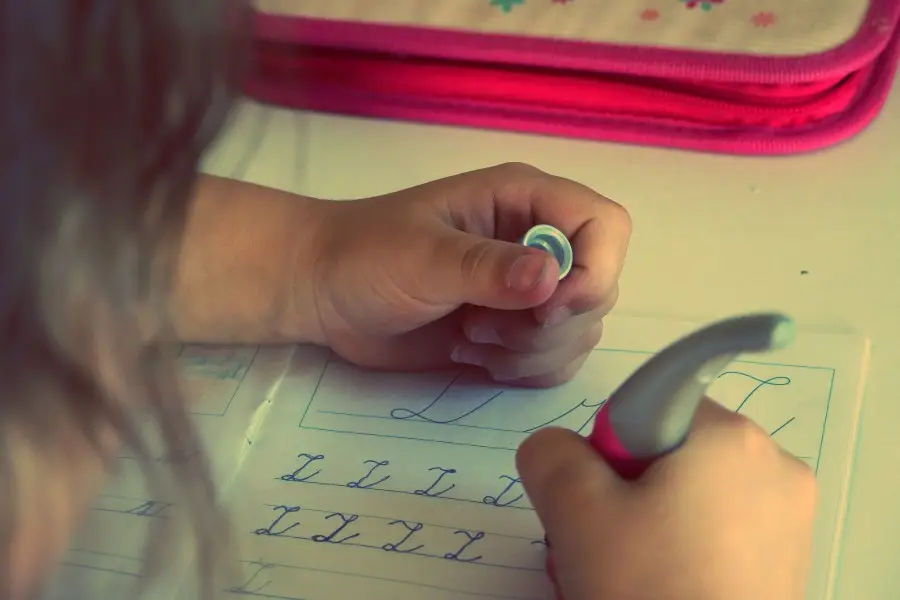
- reversing the order of letters and numbers
- confusing left and right
- skipping or rereading lines
- excessive head movement while reading
- blurred vision both near and far
- holding books too close
- squinting when looking into the distance
Vision Therapy: training to re-educate vision
Vision Therapy, also known as vision training, is a programme of exercises designed to correct and improve the various functional and perceptual visual skills. Children develop all their visual skills in much the same way as they learn to walk or talk: they also have to learn to see in order to interpret and understand the world. 20/20 visual acuity does not guarantee good vision. That is why glasses are not the answer, but Vision Therapy is: through a set of specific, personalised exercises, it can re-educate vision and make it more efficient. In Cristina Mas’s words: “For our child to be able to learn, as well as seeing clearly, they need to have developed the visual functions that are essential for reading, such as binocular vision, focusing ability and eye movements.”
When did you last take your child to an optometrist for an eye test?