
Advanced contact lenses in Barcelona
We fit contact lenses for complex cases: scleral, hybrid, rigid and custom designs, in direct coordination with ophthalmology.
What is an advanced contact lens centre?
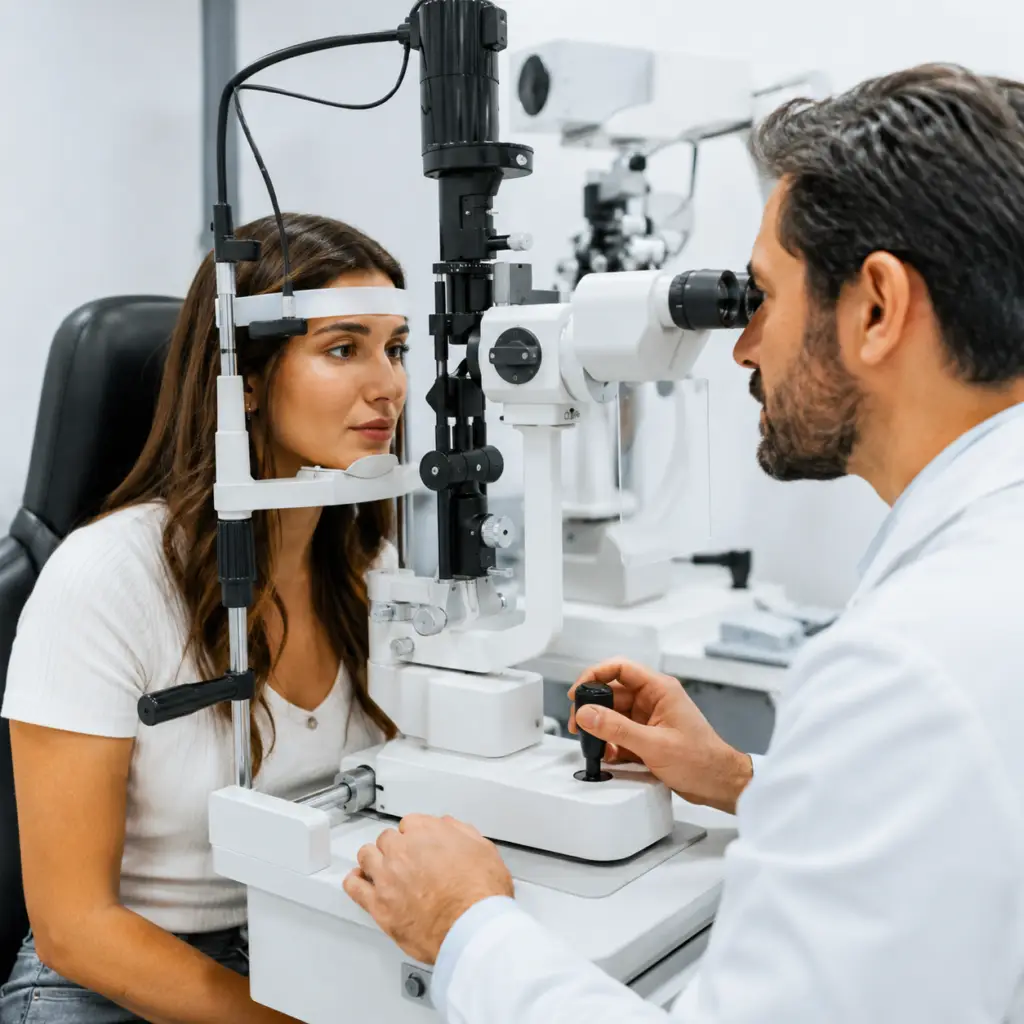
An advanced contact lens centre, like the one we run at Biòptic, offers a highly specialised service fitting contact lenses for complex cases. Unlike a general optician, it focuses on patients who need fully personalised solutions and has specific state-of-the-art technology for assessment and follow-up. This allows us to work with some of the most innovative and precise contact lens designs currently available.
This type of centre represents the highest level of eye care, where coordination with ophthalmologists is not an add-on but an essential element in guaranteeing reliable clinical results. At a time when myopia, keratoconus and various corneal disorders are on the rise, having a specialist service that works closely with medical professionals and meets current healthcare standards gives patients a great deal of safety and confidence.
When you need a specialist centre
- You've been told that “you can't wear contact lenses” or that your prescription can't be fitted.
- You have keratoconus, pellucid marginal degeneration or another corneal irregularity.
- You've had corneal surgery, a corneal transplant or refractive surgery with a poor visual result.
- Conventional contact lenses feel uncomfortable or don't give you sharp vision.
- You have severe dry eye and can't tolerate soft contact lenses.
- You're looking for myopia control for your son or daughter.
- You're colour blind and need to pass a colour discrimination test.
Types of contact lenses we fit
Scleral lenses
They rest on the sclera, the white part of the eye, and vault completely over the cornea, creating a fluid reservoir above it. They create a uniform optical surface, so they offer very high visual quality on irregular corneas. They are currently the treatment of choice for advanced keratoconus and severe dry eye.
Keratoconus: learn more →Mini-scleral and hybrid lenses
Mini-scleral lenses offer many of the advantages of scleral lenses with a smaller diameter. Hybrid lenses combine a rigid centre, which corrects the irregularity, with a soft periphery that improves comfort and stability.
Rigid gas-permeable lenses (RGP)
They correct irregular astigmatism that soft lenses can't compensate for. They allow fully customised designs based on the topography of each cornea.
Soft myopia control contact lenses
Designed specifically for children and teenagers. They correct vision and, at the same time, create therapeutic peripheral defocus that reduces the stimulus for eye growth.
Childhood myopia →Orthokeratology (Ortho-K)
Rigid reverse-geometry lenses worn overnight that let you see clearly all day without glasses or contact lenses. It is also one of the best-evidenced treatments for slowing the progression of childhood myopia.
All about orthokeratology →Contact lenses with filters for colour blindness
Contact lenses with selective spectral filters, customised to the type and severity of the colour vision deficiency.
Contact lenses for colour blindness →Paediatric contact lenses
Fitting for babies and young children, including cases of aphakia after congenital cataract surgery, with very high prescriptions and frequent changes.
Congenital and childhood cataracts →Examination and follow-up technology
Corneal topography
Analyses the curvature of the cornea and creates detailed maps.
Corneal tomography
Assesses the thickness, elevation and internal structure of the cornea.
Pachymetry
Measures corneal thickness in different areas.
Aberrometry
Identifies the optical aberrations that reduce quality of vision.
Biometry
Measures the axial length of the eye, a key figure in myopia control.
What the fitting process involves
1
Full initial examination: clinical history, refraction, topography and assessment of the ocular surface.
2
Lens selection and design based on the measured parameters.
3
Trial fitting and adjustment of parameters until the best performance is achieved.
4
Training in handling, hygiene and care.
5
Scheduled follow-up check-ups.
Frequently asked questions
I've been told my case can't be solved with contact lenses. Can I still be fitted?
In most cases, yes. Many patients turned down by a general optician can be fitted with scleral or hybrid lenses or custom designs. What determines the answer is the examination, not the prescription.
Are scleral lenses uncomfortable?
They are among the best-tolerated rigid lenses, precisely because they don't rest on the cornea. Most patients wear them for many hours a day without discomfort.
How long does a fitting take?
The initial examination requires a long appointment. After that, the fitting is usually completed over several sessions depending on the complexity of the case.
Do you work with ophthalmologists?
Yes. Coordination with ophthalmology is part of our standard protocol, especially for keratoconus, post-operative cases and paediatric conditions.
Would you like to know whether there's a solution for your case?
Start with a full examination. We'll tell you clearly what options you have.
Book an appointment